In this guide, you’ll find the essential steps to landscaping a front yard, from planning and design to plant selection and maintenance. Whether you’re starting from scratch or looking to refresh your existing landscape, these tips will help you achieve a front yard that is both aesthetically pleasing and easy to maintain.
Does your front yard need a makeover?
Need better curb appeal?
Or do you have a newly built home and are starting from scratch?
Certainly any of these scenarios can seem overwhelming to say the least.
See our essential steps as we share with you our process of landscaping a front yard.
You will find ideas for shrubs, flowers, low maintenance plants, hardscape ideas and time saving tips.
Everything you need to know to create a simply beautiful front yard.
I love a beautiful manicured yard, but I don’t have the time to spend hours each week on it.
With this in mind, we chose low maintenance plants that provide color and texture, yet do not require a lot of attention.
In this article you’ll find ideas to landscape your front yard that will give you the best curb appeal in the neighborhood.
And speaking of curb appeal, a few years back our city awarded us a prize for our landscaping, it was such an honor.
- How Much Does It Cost To Landscape a Front Yard?
- What Time Of Year Is Best To Landscape?
- Our Yard Before Updating Landscaping
- Where To Begin?
- Landscape Design Plan
- Planning The Landscape Design
- Adding a Hardscape to our Front Yard Landscape
- Front Yard Landscape Irrigation
- Landscaping with Shrubs
- What Flowers are Best for Front Yard?
- Keeping it Natural
- Compost in Flower Beds
- Budget Friendly Ideas
- Shop Landscaping Essentials
- Final Thoughts
Sunny Side Design is a participant in the Amazon Services LLC Associates Program, an affiliate advertising program designed to provide a means for sites to earn advertising fees by advertising and linking to Amazon.com. As an Amazon Associate, this blog earns from qualifying purchases with no additional cost to you. Click here to read our full disclosure policy.
How Much Does It Cost To Landscape a Front Yard?
Landscaping a front yard can cost between $1,500 to $5,000 on average and even more if you hire a landscaper.
This can vary with the size of your yard.
However, we are frugal and will share DIY ideas that will help you stay on budget, which will put a smile on your face!
Are you enjoying this project? Please Pin It, save it for later and share it with a friend.
Sharing is caring!
What Time Of Year Is Best To Landscape?
The best time to begin landscaping and planting trees, shrubs, and perennials is in the months of April and May.
These spring months will give your plants the opportunity to grow and acclimate during the summer and fall.
However, the next best time to begin landscaping is the fall.
Fall is often overlooked as a time to landscape.
But, often it is a great time to purchase plants.
In fact during the month of September you will often find trees, shrubs and perennials on sale, which means more bang for your buck.
Also fall is also a great time of year for plants to acclimate in your garden.
In addition the temperatures begin to cool, yet the soil remains warm and promotes root growth.
Just be sure not to plant too late in the season.
If you’re new here, welcome! We’re so glad you’re here.
Let us introduce ourselves, we’re Michelle and Steph, a mom and daughter team who love to DIY and decorate our homes.
Not only are we passionate about making our homes warm, comfortable and unique, but it’s our mission to help you create that same feeling in your own home.
You’ll find ideas for repurposing, creating, decorating and making your home truly yours, while always mindful of a tight budget.
Undoubtedly we love finding ways to make your home look high-end on a small budget.
Plus you’ll also find a recipe or two as we share our family favorites with you.
We’d love it if you’d join our community of doers so you won’t miss any inspiration for your home.
We love new friends.
Our Yard Before Updating Landscaping


A quick peek at the landscaping in our front yard, before we dug into it.
The photo on the left was taken in December the day we closed on our home.
And the one on the right is what our front yard looked like when spring rolled around.
Certainly we knew the inside of our home was a fixer upper, but the landscaping definitely needed some love too.
The shrubs were all overgrown and planted too close to the house.
In addition, the flower beds were unkempt and full of weeds.
Where To Begin?
Whether your yard needs a makeover, more curb appeal or it’s not landscaped at all, you may ask yourself, “where do I start”?
Clearly, a great place to start is to tackle the weeds.
Without a doubt a landscape that is weed free immediately looks better.
Then it’s time to come up with a plan.
Landscape Design Plan
The basic elements of landscape design are:
- Color
- Form
- Line
- Scale
- Texture
Color
Keep in mind how colors interplay with the color of other basic elements, such as the color of your home.
Then repeat colors around the landscape.
They do not necessarily need to be the same plant, just the same color tone.
Then you’ll also want to pay attention to how the colors play off of each other.
As I was planning the landscaping for my front yard, I loved how the light green of the Halo dogwood played off the purple tones of the Barberry and Black Lace Elderberry.
Repeating those colors throughout my yard forms a cohesive color palette.
Form
Form is the shape of a plant and the structure of its branching pattern.
When designing your landscape keep in mind the form of the mature plant.
Line
Line refers to the way your eye moves across the landscape.
Scale
Scale is simply the size of one component relative to adjacent components.
Texture
Texture is the surface of a plant as it is perceived.
Different size of leaves will create different texture as will grasses or pines, cedar or fir trees.
Let’s stay connected! Follow us on social media!
Planning The Landscape Design
First spend some time online looking at plants that you are attracted too.
Then create a file with images of these plants.
Also keep in mind of your climate and how the plants will grow in your area.
It’s definitely not worth your time and money to plant something that will not grow in your climate or soil type.
In addition, take advantage of free landscaping classes.
It’s a great place to get ideas for landscaping your front yard.
We found classes in our area at our water municipality for free that are taught by landscape designers.
This is a great way to get ideas from professionals.
When we began designing the landscape for our front yard we used smartdraw.com to create a plan.
This made it easy to see how colors and textures played off of each other.
With our design in hand, we were prepared to go purchase plants at our local nursery.
Adding a Hardscape to our Front Yard Landscape
When we purchased our home it had this odd, sort of courtyard area.
It was enclosed by 2 brick columns and an iron railing.
However in this so called courtyard there was a small circle of grass and a hedge.
Clearly, it made no sense at all.

Not to mention that the columns were unstable and were easily demolished.
However, the foundation for the columns was another story!
With 3 feet of cement, it required a jack hammer to break up the concrete.

Including a hardscape in a landscape is an ideal way to expand outdoor living area.
Hardscapes compliment the “softscaping,” that is the trees, shrubs, and flowers that provide natural beauty.
Adding a small paver patio was just what our front yard landscape needed.
It provides a place to gather and sit with friends.
Without a large porch, we love this area we created in our front yard.
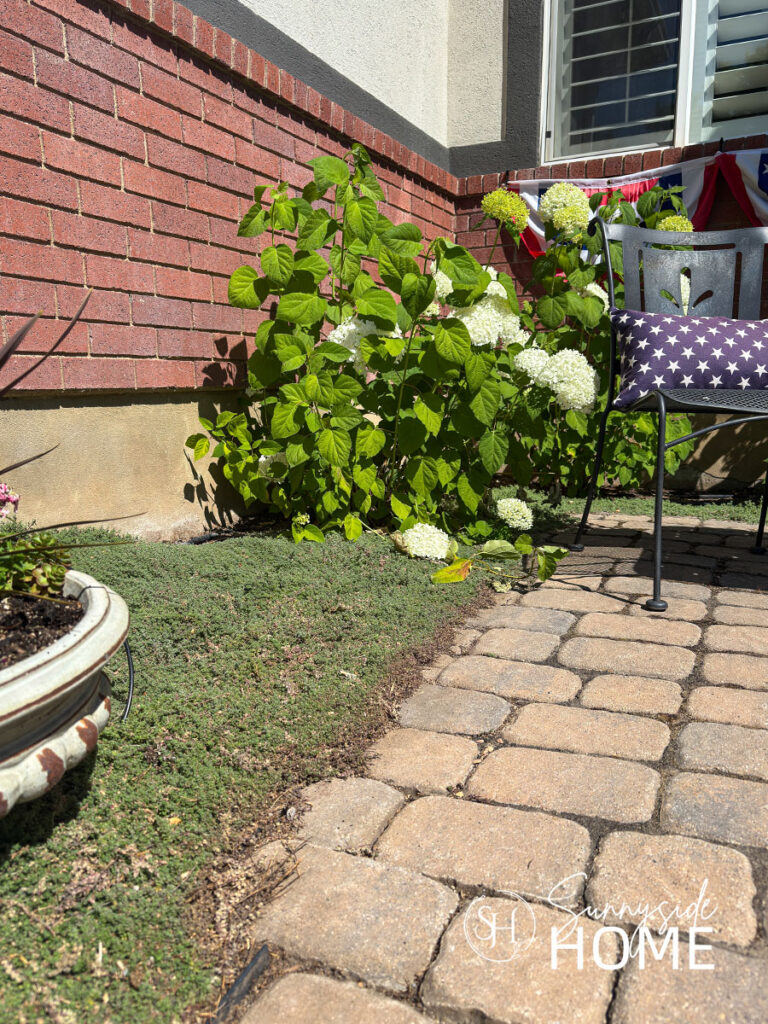
Once the paver patio was installed, we planted woolly thyme to soften the edges of the patio.
Front Yard Landscape Irrigation

If an automated irrigation system is in your budget, I would highly recommend it.
Certainly it’s difficult to manually keep a yard watered.
Since this was an existing landscape, there was already an irrigation system in place.
However, we extended flower beds and changed the overall watering pattern so adjustments needed to be made.
Also adding a drip irrigation system for the flower beds not only save water, but it also helps prevent weeds from sprouting.
This is an easy DIY that anyone can do.
And if you need help planning your irrigation system your local home improvement store can help.
Landscaping with Shrubs

The right foundation planting for most houses is a nice mix of evergreen and deciduous shrubs.
In fact, shrubs soften the hard lines of a house.
When selecting shrubs, think of mature height and width of the plants.
Above all read the tags on the plants and become familiar with their needs.
For example that cute little shrub at the nursery may soon grow to block the view from your window.
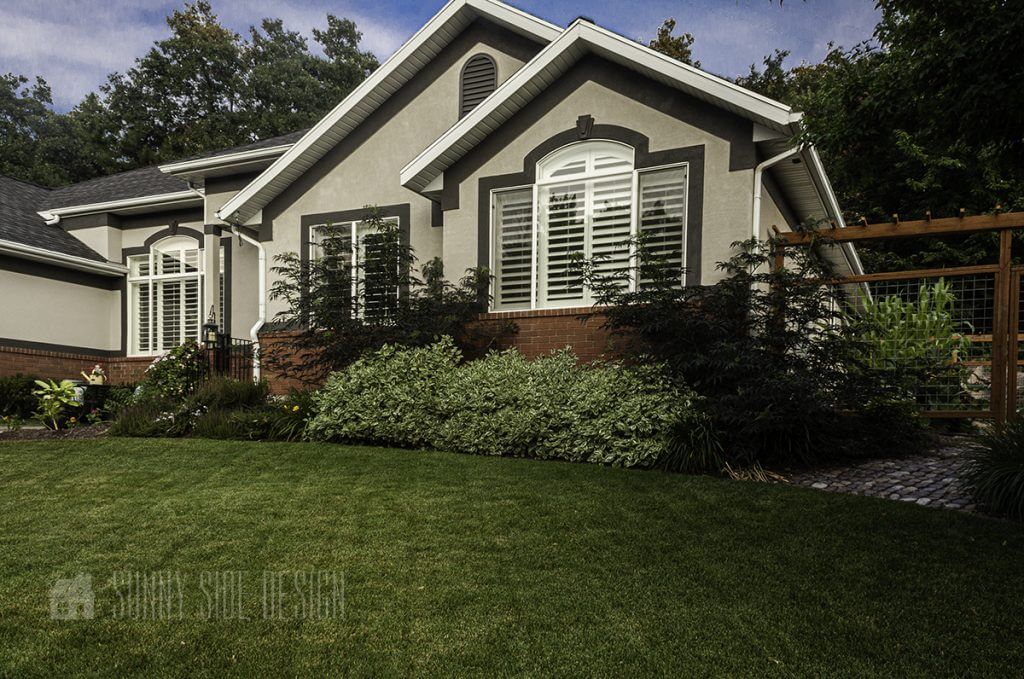
For instance in our front yard landscape we chose dwarf shrubs.
Choosing low maintenance plants that we do not need to prune, like our Halo Dogwoods and Little Lime Hydrangea.
Here are some of my favorite shrubs:
- Mugo Pine
- Halo Dogwood
- Black Lace Elderberry
- Dwarf Forsythia
- Boxwood
- Euonymus
- Barberry
- Butterfly Bush
- Hydrangea
- Burning Bush
- Snowball Bush
- Spirea
- Weilgela
What Flowers are Best for Front Yard?
Certainly a variety of perennials (flowers that come back year after year) can provide a lot of color when landscaping a front yard.
In addition, look for perennials that bloom at different times during the season.
This will provide you with color throughout the year.
Some of my favorite perennial flowers are:
- Yarrow
- Daylily
- Salvia
- Veronica
- Hosta
- Lavender
- Aster
- Chrysanthemum
- Purple Cone Flower
- Delphinium
- Annabelle Hydrangea
- Peony
- Phlox
- Shasta Daisy
- Coreopsis
I also add a few annuals (flowers than only bloom for one season) to my garden as well.
This will add color that will last the entire season.
Some of my favorite annual flowers are:
- Petunia
- Zinnia
- Geranium
- Begonia
- Impatiens
- Cosmos
- Dahlias
- Marigold
- Pansies
- Snapdragons
- Sunflowers

Clearly, I like to use as many perennials in my yard as possible.
This is a big budget saver!
Planting flowers once and enjoying them year after year can save you hundreds of dollars over the years.
Not to mention as the perenials mature, they can be divided and transplanted to other areas of your landscape.
And who doesn’t love FREE flowers?!
For instance, the perennials I’ve planted in my front yard landscape are daylily, salvia, miniature rose, hydrangea and liatris.
For constant color throughout the summer I like to add a few annuals.
This year I planted zinnias and petunias.
Certainly it’s nice to switch things up a bit each year.
Keeping it Natural

When choosing plants for my yard I want to keep them as natural as possible.
First I select dwarf shrubs so they never need to be pruned.
Also choose perennials that do not become invasive.
Clearly, weeding out perennials that have taken over a flower bed is no fun!
Use curves to keep a natural looking landscape.
You’ll never see a straight line in nature.
Use plants to draw the eye towards the front door by lining the walkway with flowers and shrubs.
Compost in Flower Beds
Compost is an efficient and practical fertilizer.
Composed of decayed organic matter, compost is a basic tool for the organic gardener.
However it is a great way to keep weeds at bay as well.
In fact, adding a 2-3″ layer of compost will greatly reduce the number of weeds in your flower garden, which means less time weeding.
We have added compost to our flower beds for years.
Not only is it a huge time saver, but it also adds wonderful nutrients to the soil.
Your plants will love you!
Budget Friendly Ideas
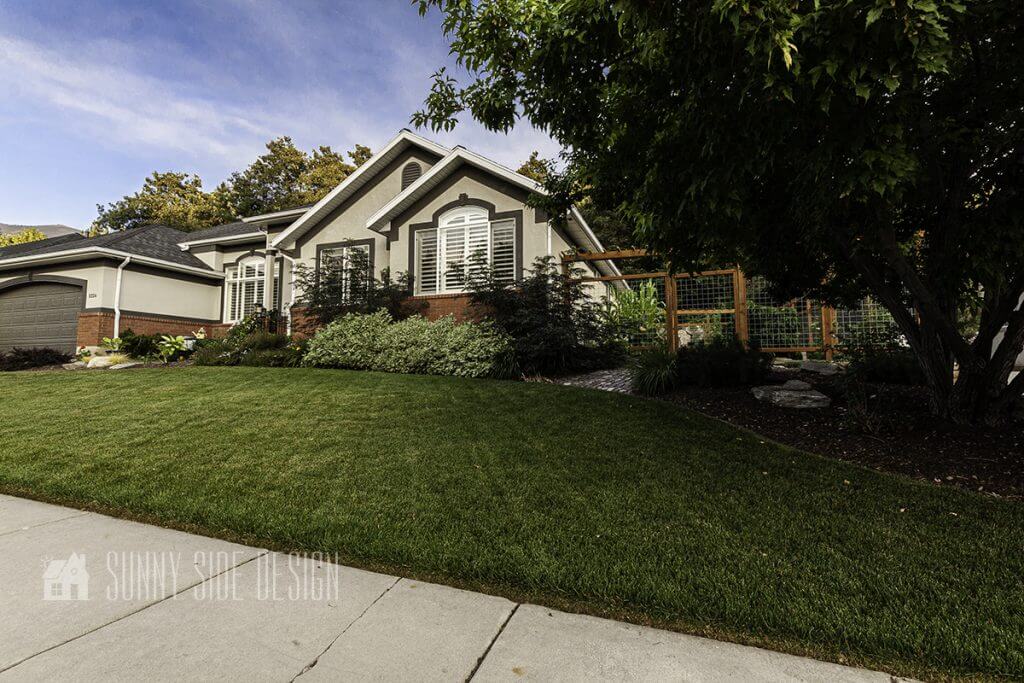
Certainly installing a new landscape can be expensive, so here are some ideas that can save you money.
DIY what you can.
Without a doubt labor cost can rack up quickly.
If there is any way that you can do it yourself, then do it!
It will save you hundreds if not thousands of dollars.
Get plant starts from friends and family.
The design plan for my front yard included the Mary Todd Daylily.
And as it happened my neighbor happened to be thinning her daylily and gave me enough plants to have 12 mounds of daylilys.
You’ve got to love FREE plants!
Another tips is to buy perennials and shrubs in the fall when they are on sale.
Look for a wholesaler in your area that may sale to the public a few times a year.
That’s exactly what we did when landscaping our front yard.
We were able to get our shrubs 50% off the retail price.
Also most landfills offer compost.
It is much less expensive than getting it through a retailer.
Add a barrier between the flower beds and the grass.
We used the inexpensive professional grade of plastic edging.
Certainly, edging is a must, or you will be weeding grass out of your flower beds.
And skip the landscape fabric for weed barriers, over time you’ll discover they just don’t work and you’ll be trying to pull weeds through the fabric.
Shop Landscaping Essentials

Final Thoughts
Landscaping your front yard doesn’t have to happen all at once or cost a fortune.
With a little planning, the right plants, and a few budget-friendly ideas, you can create a welcoming outdoor space you’ll enjoy for years to come.
Start with a simple plan, tackle one project at a time, and don’t be afraid to let your landscape evolve as your home and style change.
In fact, last year we updated our paver patio area and removed the boxwood hedge.
The deer just wouldn’t leave it alone and it was looking very shabby.
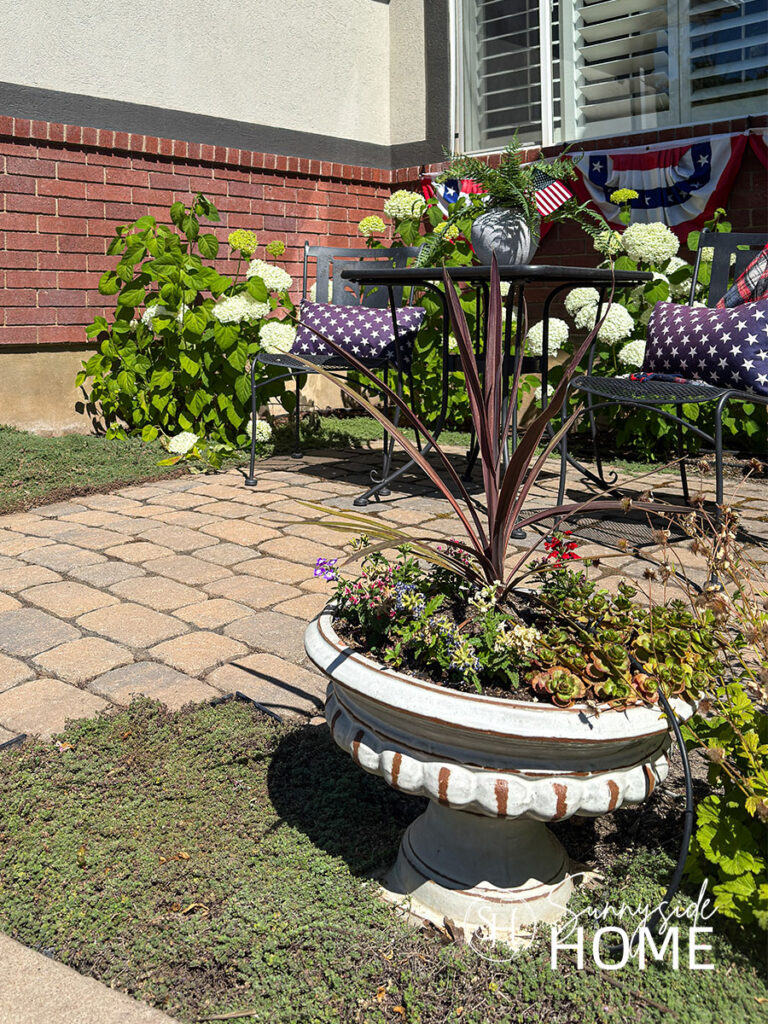
And now this area is thriving with Annabelle hydrangeas.
I am in love with the transformation here!
We hope our before and after transformation has inspired you to create a front yard that reflects your personality and makes you smile every time you pull into the driveway.
Happy landscaping!
Please share your tips and ideas with us.
We love hearing from you!
If you’re new here, WELCOME! We love having new readers and friends!
You can learn more about us here.
Let’s stay connected! Join our DIY community of doers and you won’t miss the weekly updates and more inspiration for you always on a budget.
Sharing is caring!

Thanks for stopping by Sunnyside Home. Empowering you to create a home you love!
Retailers We Love
- Anthropologie
- Birch Lane
- Crate & Barrel
- Joss and Main
- Lampsplus
- Mark & Graham
- One Kings Lane
- Pottery Barn
- Rejuvenation
- Serena & Lily
- Wayfair
- West Elm
- Williams Sonoma
- World Market
Be sure to follow us on Pinterest for even more home decor and DIY ideas.
To see what we are working on before it’s on our blog, follow us on Instagram.
You will also find our video tutorials on our YouTube channel.
- 25 Beautiful Thanksgiving Centerpiece Ideas You Can Create

- Last Minute Outdoor Halloween Decorations with Thrifted Finds

- Easy DIY Frankenstein Halloween Decor
- Simple Pumpkin Solar Lights in Under 5 Minutes